Dental Implant Warranty Mexico vs USA: Legal Protections and Malpractice Coverage Explained
Understanding the dental implant warranty in Mexico is arguably the most overlooked step in the entire cross-border treatment process, yet it directly determines your financial exposure if anything goes wrong. Approximately 59% of US adults report avoiding dental care entirely due to affordability issues, which is the primary driver pushing 550,000 or more Americans across the border for dental work annually. Before you join them, you need a clear-eyed view of exactly what warranty and legal protections exist on both sides of that border.
Key Takeaways
- Three layers of coverage: A legitimate dental implant warranty in Mexico is composed of manufacturer hardware coverage, a clinic-issued surgical warranty, and patient maintenance responsibility. All three must be in place.
- Warranty benchmarks: Reputable Mexican clinics issue 5 to 10-year warranties on implant hardware and 2 to 5 years on prosthetics such as crowns and bridges. Anything shorter deserves scrutiny.
- US legal system vs. Mexican private guarantee: In the USA, malpractice litigation is the primary safety net. In Mexico, private written guarantees and accreditation networks serve that function instead.
- Accreditation is the real predictor: Outcome data on dental implants in Mexico vs USA confirms that accreditation, not geography, is the primary predictor of implant success. A board-certified specialist operating under ISO standards carries more weight than a national flag.
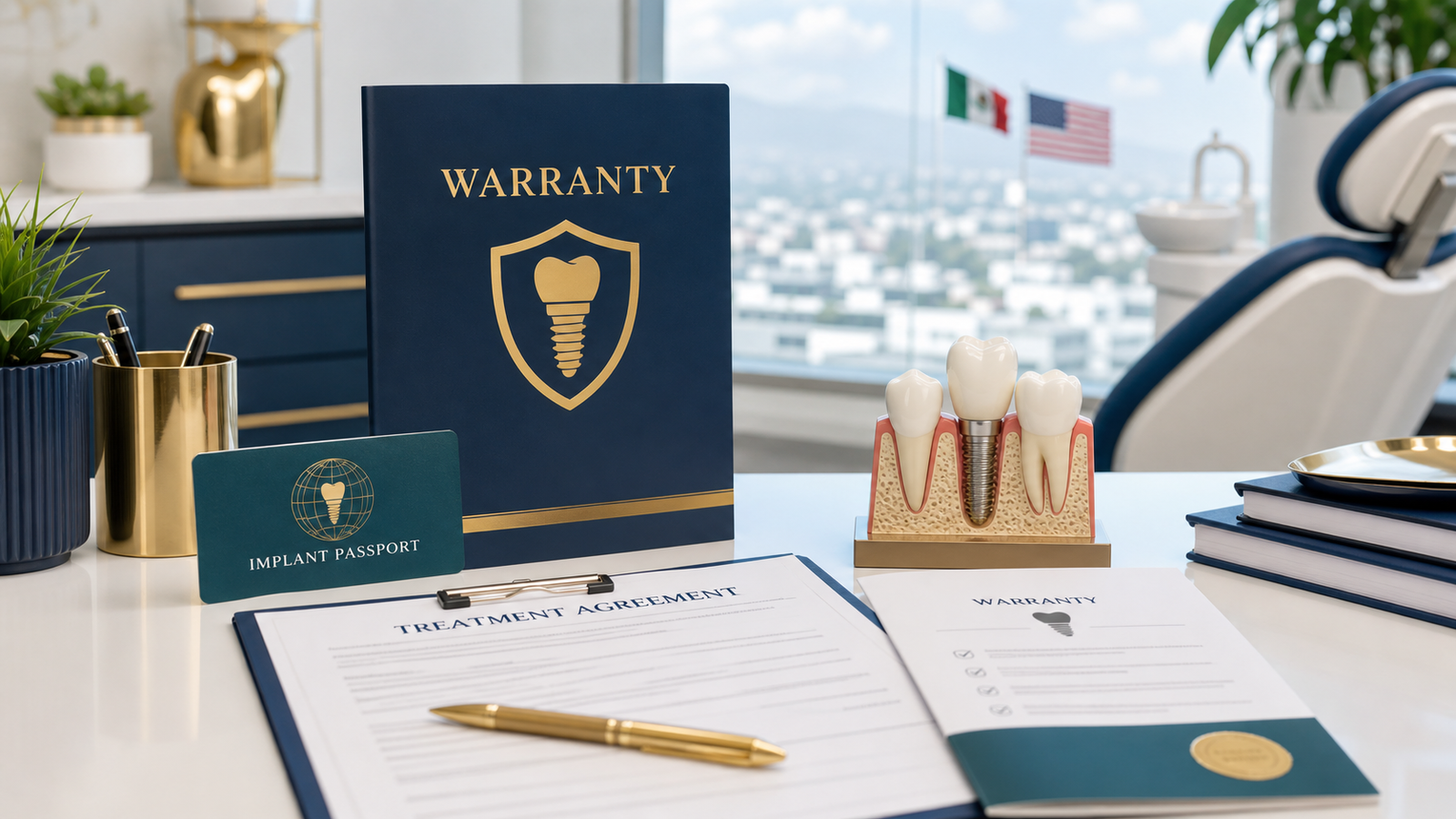
- The implant passport matters: Request the implant passport with serial numbers for every implant placed. Without it, you cannot activate manufacturer warranty coverage at any clinic worldwide.
- Hidden costs to budget for: Return travel for warranty work is a real possibility. Factor one roundtrip into your financial plan before you book.
- Rushed timelines void warranties: Complication rates in unverified cases can jump from a standard 5% to over 25% when osseointegration timelines are compressed. Your warranty is only as enforceable as the protocol that precedes it.
How the Dental Implant Warranty System in Mexico Actually Works
Coverage is not a single document. It is a combination of hardware integrity, clinical skill, and your personal maintenance. Understanding each layer is non-negotiable before signing any treatment agreement.
The first layer is the manufacturer warranty. Global brands such as Straumann, Nobel Biocare, and Zimmer Biomet issue lifetime or long-term hardware guarantees against manufacturing defects in their titanium implant fixtures. This coverage follows the serial number, not the country. If your implant passport lists a Nobel Biocare fixture placed in Tijuana, that fixture carries the same manufacturer warranty it would in Dallas.
The second layer is the clinic warranty. This is where the Mexico vs USA comparison becomes most significant. A reputable Mexican clinic will issue a written surgical warranty covering re-placement of a failed implant, adjustment of the prosthetic, or correction of a post-surgical complication within the stated term. We consistently recommend a minimum of 5 years on the fixture and 2 years on crowns or bridges as your benchmark when vetting any provider.
The third layer is patient responsibility. No warranty, in Mexico or the USA, covers implant failure caused by neglected hygiene, missed follow-up appointments, or uncontrolled systemic conditions such as unmanaged diabetes. This is not fine print. It is the clinical reality of long-term osseointegration maintenance.
Dental Implant Warranty in Mexico: What a Strong Clinic Guarantee Includes
Not every warranty document is worth the paper it is printed on. We apply our 5-Point Verification Checklist to every warranty document we review, and we recommend patients do the same.
- Written form, in English, signed by the head surgeon. A verbal promise made during a consultation is unenforceable. The warranty must be a dated, signed document you receive before treatment begins.
- Clear coverage scope. The document must specify whether it covers re-placement of a failed implant fixture, replacement of a fractured crown, correction of abutment failure, or all of the above. Vague language like "we stand behind our work" is insufficient.
- Stated duration by component. Hardware and prosthetics depreciate at different rates. A reliable warranty separates these into distinct terms rather than grouping them under one blanket period.
- Exclusion clauses in plain language. Legitimate warranties list exclusions clearly, including patient non-compliance, trauma, or changes to systemic health. If a clinic cannot tell you what voids the warranty, that is a red flag.
- Contact escalation path. The warranty should name a specific department or person responsible for processing claims, not simply list a general clinic phone number.
If a clinic in Tijuana, Los Algodones, or Cancun cannot produce a document meeting all five criteria, we advise patients to continue their research before booking.
Legal Protections in the USA: The Malpractice Framework
In the United States, dental malpractice law provides a formal legal pathway for patients who suffer harm from substandard care. Every licensed dentist carries mandatory malpractice insurance, state dental boards maintain disciplinary authority, and the civil court system is accessible to patients seeking financial redress.
This system is not without cost. US dental malpractice insurance premiums and the litigation infrastructure they support are directly embedded into US procedure pricing. That overhead burden, combined with higher facility costs and staffing expenses, is precisely why a single implant in the USA averages $3,000 to $5,000 while the same procedure using the same implant brand costs $750 to $1,200 in Mexico.
The US legal framework is robust, but it is also slow. A malpractice case can take two to four years to resolve, and statistically, the majority of dental malpractice claims never reach a monetary settlement. The theoretical strength of US legal protections is, in practice, much harder to exercise than most patients assume.
Legal Protections in Mexico: The Cédula Profesional and Private Guarantee System
Mexico operates under a different but legitimate professional licensing framework. Every board-certified dental specialist in Mexico must hold a Cédula Profesional, a federal registration number issued by the Secretaría de Educación Pública (SEP) that verifies their credentials and is publicly searchable. This is the Mexican equivalent of state licensure verification.
Cross-border legal recourse through Mexican courts is, in practical terms, inaccessible for most US patients. Filing a malpractice claim in a Mexican civil court requires local legal representation, proximity, and a timeline that makes it economically unviable for the vast majority of dental tourists.
This is why the written clinic warranty and accreditation network membership function as the primary patient protections in Mexico. Networks such as Dayo Dental establish minimum guarantee standards, requiring member clinics to maintain at least a 5-year warranty on implant procedures as a condition of participation. Choosing a clinic affiliated with a vetted network shifts some enforcement accountability to the network itself.
Lower cost reflects economic factors like reduced overhead and lower malpractice insurance, not inferior implant materials or surgical technique. The absence of a US-style litigation system does not mean the absence of accountability. It means the accountability mechanism is different, and patients need to understand precisely how to engage it.
This infographic breaks down the three layers of dental implant warranty available in Mexico. It highlights coverage scope, duration, and common exclusions to help patients compare plans.
Malpractice Insurance Cost: Why Mexico Is Structurally Less Expensive
One of the most important data points for understanding the Mexico vs USA price gap is the cost of professional liability insurance. In the USA, this cost is embedded invisibly into every fee patients pay.
It is worth noting that this structural cost difference does not represent a quality deficit on the Mexican side. A board-certified specialist in Cancun using CBCT-guided planning, Titanium Grade 4 or 5 fixtures, and a documented sterilization protocol is delivering a clinically equivalent procedure to their US counterpart. The price difference is a reflection of economic infrastructure, not clinical hierarchy.
For patients weighing this trade-off, the calculation is clear. If you select a clinically verified provider with documented success rates and obtain a written warranty meeting our 5-Point Verification Checklist criteria, you are accepting a different legal framework, not an inferior clinical one.
The Implant Passport: Your Most Important Warranty Document
The implant passport is the single most critical document you will receive at a reputable Mexican clinic. It lists the brand, model, lot number, and serial number of every fixture placed during your procedure.
Without this document, you cannot activate manufacturer warranty coverage at any clinic, in any country, in any year. If your implant fails or requires adjustment in five years and you are back in the USA, your US dentist needs that serial number to identify the fixture and determine the correct replacement components.
Request the implant passport before your final payment is made. If a clinic is reluctant to provide it, treat that reluctance as a serious due diligence flag. Every implant from a major brand produces this documentation automatically. There is no legitimate reason to withhold it.
Long-Term Aftercare and Warranty Maintenance Requirements
A dental implant warranty in Mexico, like any warranty anywhere, is a conditional document. Meeting its terms requires active patient participation, not passive receipt of care.
Long-term dental implant aftercare includes biannual professional cleanings, X-ray monitoring to assess bone density around the fixture, and checking the torque on abutment screws every 12 to 18 months. Peri-implantitis, the inflammatory condition that is the leading cause of late implant failure, is almost entirely preventable with consistent maintenance.
If your US-based dentist is monitoring your Mexican implants, document every appointment. Keep a maintenance log that includes dates, clinician names, and the specific procedures performed. This documentation protects you if a warranty claim ever requires evidence of compliance.
- Schedule biannual professional cleanings within the first year post-osseointegration
- Request annual periapical X-rays to monitor crestal bone levels
- Ask your restorative dentist to check abutment screw torque every 12 to 18 months
- Report any mobility, pain, or gum inflammation immediately rather than waiting for a scheduled appointment
- Maintain your implant passport and warranty document in a dedicated dental file, separate from general health records
Comparing Dental Implant Warranty Options: Mexico vs USA Side by Side
| Factor | Mexico (Accredited Clinic) | USA (Board-Certified Specialist) |
|---|---|---|
| Implant fixture warranty | 5 to 10 years (written) | Manufacturer lifetime (written rarely offered by clinic) |
| Prosthetic warranty | 2 to 5 years (written) | 1 to 3 years (varies widely) |
| Legal recourse | Private guarantee and network enforcement | State dental board and civil malpractice litigation |
| Licensing verification | Cédula Profesional (publicly searchable) | State license (publicly searchable) |
| Average single implant cost | $750 to $1,200 | $3,000 to $5,000 |
| Implant passport provided | Yes (at reputable clinics) | Yes (standard practice) |
| Hidden costs to budget for | Return travel for warranty work | Higher insurance premiums embedded in fees |
What Voids a Dental Implant Warranty in Mexico
Every legitimate warranty document contains an exclusion section, and patients need to read it with the same attention they would give to a financial contract. Common exclusions at Mexican implant clinics include the following:
- Patient non-compliance with aftercare instructions, including failure to attend follow-up appointments within the stated window
- Trauma or physical injury to the implant site after placement, including sports injuries or accidents
- Uncontrolled systemic disease that was not disclosed prior to treatment, including poorly managed diabetes or autoimmune conditions affecting bone density
- Tobacco use initiated or continued after placement, which clinical data links directly to elevated peri-implantitis risk
- Modification of the prosthetic by a third-party dentist outside the issuing clinic without prior written approval
- Failure to return for warranty assessment within the timeframe specified in the document
Understanding these exclusions protects you from a scenario where you assume warranty coverage applies, only to find that a specific condition voided it. We advise patients to read the exclusion clause of any warranty document before, not after, the procedure is performed.
Our Recommendation: How to Protect Yourself Before You Travel
We recognize that dental implants are a significant life investment, both financially and physically. Our data-driven, patient-focused approach to this guide is built on the premise that informed patients have better outcomes, not because they avoid risk, but because they know precisely which risks they are accepting and which ones they have mitigated.
Before booking any procedure, confirm the following with your prospective clinic in writing:
- Request the full warranty document in English, including all exclusion clauses, before paying any deposit.
- Verify the lead surgeon's Cédula Profesional number against the SEP public registry.
- Confirm the implant brand and request the manufacturer's warranty documentation alongside the clinic warranty.
- Ask explicitly whether the clinic is affiliated with any patient network or guarantee program that provides independent oversight.
- Budget one return trip as a hidden cost in your total financial plan, in case warranty work becomes necessary.
You can explore the full Mexico vs USA dental implants comparison for a broader cost and quality analysis, or review our complete dental implant warranty and aftercare guide for detailed post-procedure protocols.
Conclusion
The dental implant warranty landscape in Mexico is more structured and enforceable than many patients expect, provided they choose clinics that issue written, term-specific, component-divided warranty documents rather than informal assurances. The absence of a US-style malpractice litigation framework does not mean the absence of accountability. It means the accountability tools are different: the Cédula Profesional, written clinic guarantees, accreditation networks, and the implant passport are your primary instruments of protection.
Our independent research platform exists to bridge the information gap between international patients and the full complexity of Mexican dental care. No paid placements, ever. Every warranty comparison, legal framework analysis, and clinic verification checklist on this site serves one person only: the patient making one of the most consequential health and financial decisions of their year.
Top-tier Mexican dental clinics report a 95 to 98% success rate for single implants, statistically identical to US outcomes. The dental implant warranty in Mexico, when properly documented and understood, protects you from the rare failure scenarios in a system that already performs at parity with its US counterpart. Do the due diligence, get it in writing, and keep your implant passport. The rest follows from that.
Frequently Asked Questions
What is a typical dental implant warranty in Mexico and how long does it last?
A standard dental implant warranty in Mexico at a reputable, accredited clinic covers the titanium fixture for 5 to 10 years and the prosthetic crown or bridge for 2 to 5 years. Both terms should appear as separate line items in a written, signed document provided before treatment begins.
Is a dental implant warranty from a Mexican clinic legally enforceable if I live in the USA?
A written warranty issued by a Mexican clinic is a contractual document enforceable under Mexican civil law, but cross-border litigation is practically inaccessible for most US patients. Your most effective recourse is selecting a clinic affiliated with a patient guarantee network, such as Dayo Dental, which enforces minimum warranty standards on member clinics as a condition of participation.
Do Mexican dental implant warranties cover the same things as US warranties?
Component-for-component, a strong dental implant warranty in Mexico covers fixture failure, prosthetic fracture, and abutment adjustment in ways comparable to what US clinics offer. The primary difference is not coverage scope but enforcement mechanism: in the USA you have state dental boards and malpractice litigation; in Mexico you rely on the written clinic guarantee and any affiliated patient network.
What voids a dental implant warranty at a clinic in Mexico?
Most warranty exclusions include patient non-compliance with aftercare, tobacco use after placement, undisclosed systemic conditions, trauma to the implant site, and modification of the prosthetic by a third-party provider without written approval. Reading the exclusion clause before treatment is non-negotiable.
Is it safe to get dental implants in Mexico if there is no US malpractice protection?
The consensus answer to "is it safe to get dental implants in Mexico?" is yes, provided you research clinics with documented infection control standards, verified Cédula Profesional credentials, CBCT-guided surgical planning, and a written warranty. The lack of US malpractice jurisdiction does not equal the absence of clinical quality standards.
Do I need an implant passport for my dental implant warranty in Mexico to be valid?
Yes. The implant passport, which lists the brand, model, and serial number of every fixture placed, is the foundational document for both the manufacturer warranty and the clinic warranty. Without it, neither warranty can be activated at any clinic, in any country, at any future date.
How do I verify that a Mexican dentist is legitimately licensed before trusting them with an implant procedure?
Request the treating surgeon's Cédula Profesional number and verify it against the publicly searchable SEP federal registry at cedulaprofesional.sep.gob.mx. This is the Mexican federal licensing credential that confirms postgraduate specialist training and is the direct equivalent of verifying a US state dental license before treatment.