Hidden Costs of Dental Tourism: Travel, Lodging, and Follow-up Care Expenses Explained
Dental tourism travel costs extend far beyond the quoted procedure price, and most patients discover this only after they've committed to a trip. According to House Dental's 2025 analysis, travel logistics including flights, lodging, and meals can erase 40% to 60% of the initial "sticker savings" on a dental procedure. Understanding what those additional costs look like in practice is the difference between a genuinely cost-effective treatment journey and a financial miscalculation.
Key Takeaways
- Dental tourism travel costs include flights, hotels, meals, local transport, and missed income during recovery. These are rarely itemized in clinic quotes.
- The Two-Trip Protocol is standard for most implant restorations. Osseointegration requires 3 to 6 months between surgical placement and final loading, meaning you budget for two separate journeys. Learn more in our hidden costs of dental tourism guide.
- All-on-4 procedures in Mexico still deliver savings of $12,000 to $20,000 per arch compared to U.S. averages, even after travel costs are factored in.
- Border cities like Los Algodones significantly reduce dental tourism travel costs for U.S. patients by eliminating the need for flights and expensive hotels. See our Los Algodones dental implants guide for a full breakdown.
- Warranty and follow-up care are part of your true cost calculation. Clinics that offer multi-layer warranties reduce the financial risk of complications requiring additional visits.
- A contingency fund of 15% to 20% above the quoted price is the standard recommendation to cover unexpected travel variables and last-minute scheduling changes.
- 63.3% of dental tourists cite clinic accreditation as their primary selection factor, ahead of cost, which reinforces that transparent pricing must be paired with verifiable clinical standards.
Understanding the Full Scope of Dental Tourism Travel Costs
The clinic quote you receive covers the procedure, the implant hardware, and (in most reputable cases) the temporary restoration. It does not cover flights, hotel nights, airport transfers, meals during recovery, or the income you forgo while away from work.
These components are not incidental. For a patient traveling from the U.S. Midwest to Playa del Carmen for an All-on-4 restoration, round-trip airfare alone can run $400 to $800 per trip. Add four to six hotel nights at $80 to $150 per night, ground transport, and meals, and the total travel overhead for a single trip reaches $1,200 to $2,500 before any dental work begins.
Multiply that across two required trips, and the picture changes materially. "Lower treatment pricing abroad can offer significant savings, but your true total depends on travel logistics, recovery time, warranties, and long-term follow-up." This is the calculation most patients skip.
Flight Costs and Transportation: What to Budget Per Trip
Dental tourism travel costs vary significantly depending on your departure city and chosen destination. Mexico's border cities, Tijuana and Los Algodones, are accessible by car for millions of patients in California, Arizona, and Nevada. No flight required. A same-day border crossing eliminates the single largest line item in most travel budgets.
For patients traveling to interior destinations such as Guadalajara, Mexico City, or Playa del Carmen, flights are unavoidable. Budget the following ranges for 2026 pricing:
- Short-haul U.S. domestic + regional connection (e.g., Phoenix to Los Cabos): $200 to $500 round-trip
- Mid-haul (e.g., Chicago or Dallas to Cancun): $350 to $750 round-trip
- Long-haul international (e.g., U.S. to Turkey or Costa Rica): $700 to $1,800 round-trip
Ground transport at your destination adds $20 to $150 per round-trip clinic transfer, depending on whether you take a taxi, rideshare, or pre-arranged clinic shuttle. Always confirm whether your clinic offers a transport package. Many top-tier clinics serving medical travelers include airport pickup in their care coordination service.
Lodging and Accommodation Costs Across Dental Tourism Destinations
Accommodation is the second-largest component of dental tourism travel costs. Recovery after oral surgery requires rest, access to soft food, and proximity to your clinic. Budget hotels within walking distance of dental districts in cities like Los Algodones, Tijuana, or Cancun range from $60 to $130 per night. Boutique resort-adjacent options in Playa del Carmen range from $120 to $250 per night.
For a standard implant placement trip requiring four nights on-site, accommodation costs range from $240 to $1,000 depending on destination and accommodation category. For patients prioritizing comfort during recovery, the Riviera Maya's resort environment represents a genuine differentiator. Our Playa del Carmen dental implants guide details how boutique clinics there integrate resort-style recovery environments with clinical-grade care.
Meals during recovery add a modest but real cost. Soft diets post-surgery limit dining options. Budget $30 to $60 per day for meals during a four-night stay, adding $120 to $240 per trip to the total.
The Two-Trip Protocol and Its Impact on Dental Tourism Travel Costs
The Two-Trip Protocol is one of the most consistently misunderstood components of dental tourism travel costs. Most high-value restorations, including single implants with crowns, All-on-4 fixed bridges, and full-mouth rehabilitations, require two separate trips to complete.
Here is the standard timeline:
- Trip 1 (Days 1 to 4): Consultation with CBCT-guided imaging, surgical implant placement, and fitting of a temporary restoration. The patient returns home to recover.
- Osseointegration Period (Months 3 to 6): The titanium implant post fuses with the jawbone. This phase happens at home and requires no travel, though local follow-up X-rays may be advisable.
- Trip 2 (Days 1 to 3): Final restoration fitting, occlusal adjustments, and delivery of permanent prosthetics. Shorter than the first trip but equally necessary.
The practical consequence is that your dental tourism travel costs are not a single-trip calculation. A patient whose quoted procedure costs $12,000 should realistically add $2,000 to $4,000 in cumulative travel and accommodation to arrive at a true out-of-pocket figure.
Even so, total costs remain dramatically lower than U.S. equivalents. Patients realistically save between $12,000 and $20,000 per arch on All-on-4 implants in Mexico versus U.S. averages, which means the travel overhead does not erode the core financial case. It simply needs to be planned for honestly.
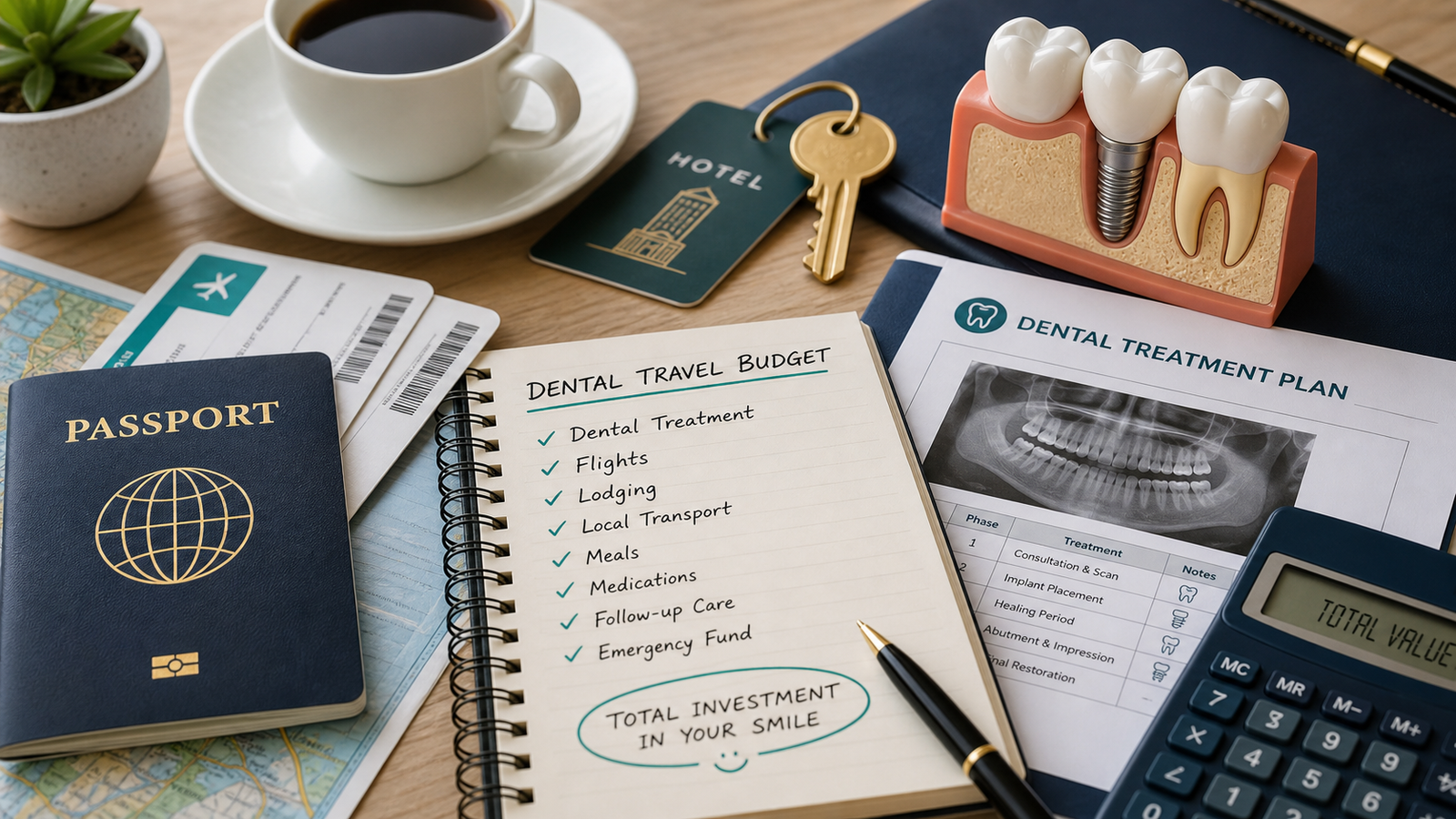
This infographic breaks down the five cost factors involved in dental tourism travel. It helps you compare clinics, travel, and accommodation to plan a budget-friendly trip.
Follow-up Care Costs: The Variable Most Patients Underestimate
Follow-up care is the category of dental tourism travel costs that creates the most financial surprises. The osseointegration period between Trip 1 and Trip 2 is not clinically passive. Complications can arise, including implant mobility, soft tissue inflammation, or prosthetic adjustment needs, that require clinical attention before the scheduled return visit.
If those issues cannot be managed remotely with your home-country dentist, an unscheduled third trip may be required. This is where the cost calculation shifts significantly. An emergency return trip to Mexico or further afield adds another $1,000 to $3,000 in travel overhead, on top of any additional clinical costs.
The structural safeguard against this risk is choosing a clinic with a robust warranty framework. Reputable clinics structure their guarantees across three layers: manufacturer warranty on the implant hardware itself, clinic warranty covering workmanship and procedural outcomes, and patient responsibility for hygiene and follow-up compliance. "Patient compliance with post-operative protocols is the single biggest variable affecting the dental implant success rate in Mexico: hygiene, no smoking, and scheduled follow-ups are critical."
We only feature clinics that utilize the protocols detailed in our comprehensive safety guide and back their work with solid warranty and aftercare policies. Understanding that coverage across all three layers is essential before you commit to any destination. Coverage isn't just one document.
Mexico vs. Other Destinations: Comparing Total Dental Tourism Travel Costs
Destination selection has a direct and quantifiable effect on total dental tourism travel costs. The comparison is not purely about procedure pricing. It is a composite of proximity, flight cost, accommodation cost, number of required trips, and clinic accreditation level.
Here is how the major destinations compare for a North American patient in 2026:
| Destination | Round-Trip Flight (approx.) | Lodging Per Trip (4 nights) | Est. Travel Overhead (2 trips) | All-on-4 Procedure Cost |
|---|---|---|---|---|
| Los Algodones, Mexico | $0 (drive-in) | $240 to $520 | $500 to $1,200 | $8,500 to $11,500 |
| Tijuana, Mexico | $0 to $300 (drive or short flight) | $320 to $600 | $700 to $1,600 | $8,500 to $11,500 |
| Playa del Carmen, Mexico | $350 to $750 | $480 to $1,000 | $2,000 to $4,000 | $8,500 to $11,500 |
| Costa Rica | $400 to $900 | $560 to $1,200 | $2,200 to $4,800 | $8,000 to $13,000 |
| Turkey | $700 to $1,800 | $400 to $900 | $3,000 to $7,000 | $6,000 to $10,000 |
For a direct cost-and-quality comparison between Mexico and the U.S. specifically, our Mexico vs. USA dental implants comparison walks through the full picture including warranty structure and proximity-based follow-up logistics.
For patients weighing Mexico against Central American alternatives, our Mexico vs. Costa Rica dental implants guide provides a 2026 cost comparison matrix that includes destination-specific travel overhead in the total savings calculation.
How to Build an Accurate Dental Tourism Travel Cost Budget
Accurate budgeting for dental tourism travel costs requires a structured approach. Use the following framework before you commit to any clinic or destination:
- Get the full clinical quote in writing. Ensure it itemizes the implant brand, implant post, abutment, crown or bridge, temporary restoration, CBCT imaging, and surgical fees separately.
- Identify your required number of trips. Single implants with straightforward bone density may be completed in fewer visits; All-on-4 and full-mouth restorations standardly require two trips across 3 to 6 months.
- Calculate per-trip travel overhead. Use the destination comparison above as a baseline, then adjust for your specific departure city and accommodation preferences.
- Add a contingency fund of 15% to 20%. This accounts for scheduling changes, extended recovery stays, or incidental expenses that fall outside the planned itinerary.
- Request your Implant Passport. Always request an Implant Passport, a document listing the exact serial numbers and brands used, allowing any dentist globally to service your hardware. This document reduces the risk of costly compatibility issues during follow-up care at home.
Pro Tip: Ask your clinic directly whether they have a North American patient coordinator. Coordinators at accredited clinics handle transport arrangements, hotel partnerships, and post-operative communication in English, which meaningfully reduces logistical overhead for international patients.
Insurance, Global Patient Coverage, and Financing Options
Standard U.S. dental insurance does not cover procedures performed abroad. However, Global Patient insurance products specifically designed for medical and dental tourism have expanded significantly in 2026. These policies cover complications arising from procedures performed at accredited international clinics, including emergency return travel costs.
Premium costs for Global Patient travel-and-procedure insurance range from $150 to $400 depending on the procedure value and duration of coverage. For an All-on-4 case valued at $10,000 to $12,000, this represents a 1.5% to 4% insurance premium, a rational expenditure given the follow-up cost exposure it eliminates.
Navigating the financial landscape of international dental care doesn't have to be complex. Many clinics work with financing partners that allow patients to split procedure costs into monthly installments, which separates the clinical payment timeline from the travel cost timeline and reduces upfront cash pressure.
For a full overview of financing structures that apply specifically to Mexico-based dental procedures, see our Mexico dental implants cost guide, which covers payment options alongside a detailed procedure-by-procedure price breakdown.
Choosing a Destination That Minimizes Dental Tourism Travel Costs
For patients whose primary objective is maximizing net savings, proximity to the U.S. border is the single most effective cost-reduction variable in the dental tourism travel cost equation. Los Algodones, Baja California, is accessible by car from the U.S. Southwest and hosts a high concentration of credentialed implant clinics within a compact geographic area.
"Save 50 to 70% on world-class full-arch restorations vs. U.S. and Canada prices." That savings range holds even after travel overhead at border-region destinations, where cumulative travel costs across two trips can be kept below $1,000 for patients within driving range.
For patients who value recovery environment, Playa del Carmen and the Riviera Maya offer boutique-clinic experiences with walkable resort infrastructure. Dental implants in Mexico have a 90 to 98% long-term success rate, depending on procedure type and patient health, at both border-region and resort destinations. The clinical quality differential between these two tiers is minimal when clinics are selected through a rigorous vetting process. "Reliability is driven by mandatory CBCT imaging and the exclusive use of medical grade-5 titanium."
Our independent clinical audits apply a 42-point quality check by our medical review board to every clinic we feature. That standard applies uniformly whether the clinic is in Los Algodones, Tijuana, Guadalajara, or Playa del Carmen.
Conclusion
Dental tourism travel costs are real, quantifiable, and manageable, provided you include them in your planning from the outset. The combination of procedure savings and travel overhead still produces a compelling financial case for Mexico-based dental care, particularly for complex restorations like All-on-4 and full-mouth rehabilitation. The key is transparent pricing, structured budgeting, and choosing a clinic with the warranty framework and aftercare policies to support a multi-trip treatment journey.
Use the tools available to you: get a full itemized quote, calculate per-trip travel overhead by destination, add a 15 to 20% contingency buffer, secure your Implant Passport, and verify clinic accreditation before you commit. For a complete starting point, visit our Mexico dental implants guide, which brings all of these components together into a single patient authority resource.
Frequently Asked Questions
How much do dental tourism travel costs add to a procedure done in Mexico?
For a standard All-on-4 restoration requiring two trips, dental tourism travel costs typically add $2,000 to $4,000 in flights, hotels, ground transport, and meals. Border-region destinations like Los Algodones can reduce this to under $1,000 for patients within driving distance of the U.S.-Mexico border.
Is dental tourism in Mexico still worth it after you factor in travel and lodging costs?
Yes, in most cases. Patients save $12,000 to $20,000 per arch on All-on-4 implants in Mexico compared to U.S. pricing, and even after accounting for $2,000 to $4,000 in travel overhead, the net savings remain substantial. The key is completing a full cost calculation before committing to a destination or clinic.
Why do dental tourists need to make two trips instead of one?
Most implant restorations require a Two-Trip Protocol because osseointegration, the process by which the titanium post fuses with the jawbone, takes 3 to 6 months to complete. Surgical placement happens on the first trip, and the permanent restoration is fitted on the second trip after the implant has fully integrated.
What hidden costs do dental tourists most commonly overlook?
The most consistently overlooked dental tourism travel costs are accommodation for an extended recovery stay, meals during a soft-diet recovery period, the cost of a second trip for final restoration fitting, and the expense of an unplanned emergency visit if a complication arises between trips. A contingency fund of 15% to 20% of the procedure price covers most scenarios.
Does U.S. dental insurance cover procedures done abroad?
Standard U.S. dental insurance does not cover procedures performed in Mexico or other international destinations. Global Patient insurance products designed specifically for dental tourism exist in 2026 and can cover complications and emergency return travel. Patients should also ask their chosen clinic for written warranty documentation covering both the implant hardware and the clinical workmanship.
Which destination has the lowest total dental tourism travel costs for U.S. patients?
Los Algodones, Mexico is consistently the lowest total-cost destination for U.S. patients when travel overhead is included, because it is accessible by car from Arizona and California with no flight costs and affordable same-day clinic access. Tijuana is the second most cost-efficient option for West Coast patients, with similar procedure pricing and manageable ground transport logistics.
How do Mexico's dental tourism travel costs compare to Turkey or Costa Rica?
Mexico has structurally lower dental tourism travel costs for North American patients because of geographic proximity, shorter flights, and the option of border-town drive-in access. Turkey requires transatlantic flights adding $700 to $1,800 per round trip per visit, while Costa Rica requires flights in the $400 to $900 range per visit. For comparable clinical quality using Tier-1 implant brands, Mexico delivers the best total-cost outcome for patients departing from the U.S. or Canada. See our full Mexico vs. Turkey dental implants comparison for a detailed breakdown.